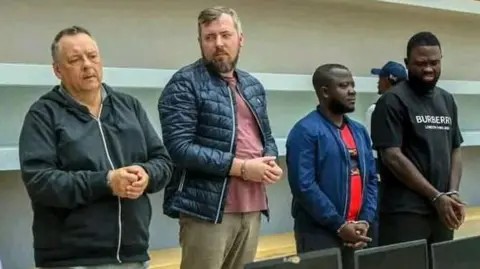
Two Russian men are set to stand trial in Angola, accused of running a covert campaign to sow dissent, spread false information and interfere in next year’s presidential vote.
Igor Ratchin and Lev Lakshtanov were detained in August and face 11 counts including terrorism, espionage and illicit influence.
Angolan prosecutors say their activities were part of a wider operation tied to a network that emerged from figures linked to the Wagner Group.
Authorities also charged two Angolan nationals, sports journalist Amor Carlos Tomé and activist Francisco Oliveira, accusing them of assisting the alleged operation.
Prosecutors say the schemes included payments to local journalists and opinion-makers — transactions that totalled just over $24,000.
The indictment, seen by the BBC, says the Russians entered Angola claiming they wanted to open a Russian cultural centre in Luanda — a project that never came to fruition.
Investigators allege the visitors used media placements and fake pages to amplify messages critical of Angola’s western orientation and development projects.
Prosecutors point to examples such as posts mimicking a local news outlet that warned Angola could be dragged into the Ukraine war, and articles critical of the Lobito Corridor rail project.
Some publications were placed via intermediary channels, and at least one site told reporters it did not write or receive payment for the pieces in question.
Angolan authorities say the operation aimed to undermine confidence in the government’s foreign partners and to alter the country’s political trajectory.
The accused are alleged to have met senior figures across the political spectrum and to have offered campaign support to potential presidential contenders — claims that defence lawyers say are unproven and, in places, factually inconsistent.
The case has raised doubts about the indictment itself.
Defence teams argue it lacks concrete evidence and note errors and timeline problems, including a disputed arrival date for a Wagner-associated operative cited in the document.
Legal experts say the prosecution will need to demonstrate a clear, intentional pattern linking the acts to a deliberate plan to subvert the state.
Observers see the episode against a backdrop of shifting Angolan diplomacy.
Once a close Moscow partner, Angola has moved toward Western ties in recent years.
Russian companies have also pulled back under sanctions tied to the Ukraine conflict, making Luanda a more contested arena for influence.
Some former associates of Prigozhin and Kremlin-linked actors scoffed at the operation, describing the effort as poorly run.
Meanwhile, many Angolan activists and journalists insist the mass unrest that shook the country last July sprang from domestic grievances over living conditions, not foreign manipulation.
If convicted, the Russians could face deportation.
Moscow appears reluctant to intervene, with diplomatic sources suggesting the men were independent contractors rather than state agents.
The trial will test Angola’s ability to prove a foreign-directed campaign to destabilise its politics and shape the debate ahead of a crucial election.