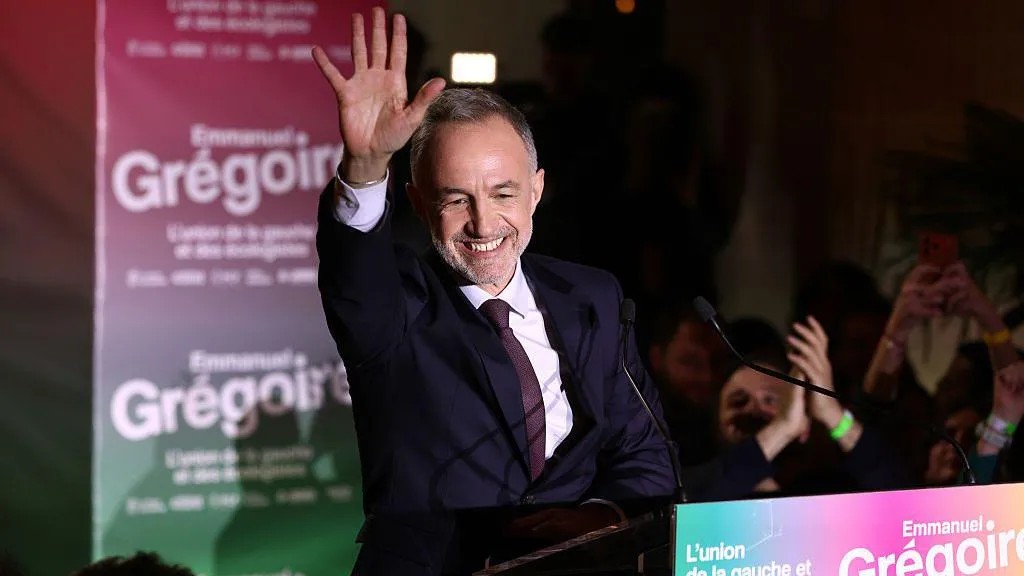
France's Socialist incumbents held onto the country's four biggest cities — Paris, Marseille, Lyon and Lille — in local elections that offered a boost to established parties ahead of next year's presidential contest.
The results suggested a retreat from political extremes in many urban centres, even as the far left and far right made selective advances in other areas.
Parties across the centre-left, centre and centre-right picked up enough wins to claim the night for the political mainstream.
The far-left France Unbowed (LFI) scored wins in some working-class suburbs, including Roubaix and a first-round victory in Saint-Denis, and its leaders hailed growing momentum.
But LFI fell short of expectations in many cities where it had tried to ally with mainstream left parties.
Many planned cooperation pacts between the Socialists and LFI failed to deliver.
In long-standing Socialist strongholds such as Clermont-Ferrand and Brest, voters instead leaned toward centrist or right-leaning alternatives, undercutting the left’s unity strategy.
Lyon stood out as an exception.
The Green mayor, who partnered with LFI, managed to hold on despite a weak challenge from a right-wing businessman.
Party officials on the Socialist side described the broader alliance experiment as risky and often counterproductive.
Paris remained a left-leaning stronghold, with the incumbent administration returned to office amid debates over traffic and urban policy.
The right-wing candidate there, a former minister, proved polarising; legal troubles and last-minute endorsements from the far right complicated the race.
The far-right National Rally (RN) had mixed fortunes.
It failed to capture its main targets in Marseille and Toulon after opponents consolidated to block it.
At the same time, RN-backed candidates succeeded in several smaller towns, including Montargis, Carcassonne and La Seyne-sur-Mer.
A notable win on the right came in Nice, where a high-profile conservative defeated the incumbent.
The RN hailed this as evidence of a shifting right that is more willing to cooperate across its factions.
Centrist forces also enjoyed significant victories.
The pro-Macron Renaissance party secured Bordeaux, with a former minister poised to take the mayoralty from the Greens.
In Le Havre, Edouard Philippe — Macron’s former prime minister — won re-election, fueling speculation about a possible 2027 presidential bid.
Overall, the election night underscored the resilience of mainstream parties across the political spectrum.
Their success may bode well for any future presidential run-off pitting a moderate candidate against an extremist one — though some analysts warned of a thorny scenario if two fringe candidates reached a national head-to-head.
For now, centre, centre-left and centre-right leaders will view the results as a tempering of political volatility, while both the far left and far right consolidate support in specific communities.
The coming year will reveal whether these local patterns translate into national momentum.