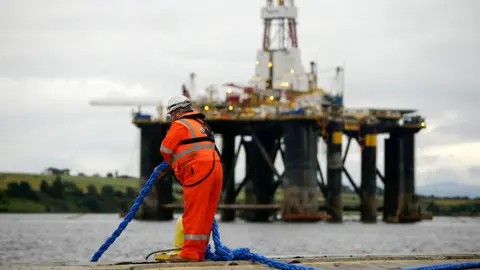
A leading offshore trade group has urged the UK government to allow more North Sea oil and gas activity, warning that shrinking domestic output is leaving the nation exposed to volatile global markets.
Offshore Energies UK (OEUK) said recent supply shocks and rising crude prices have underlined the need for more home-grown hydrocarbons to reduce import dependence.
The trade body pointed to tightening markets after recent unrest in the Middle East and disruptions around the Strait of Hormuz, which helped push oil prices sharply higher.
The Labour government has barred new licences for fresh North Sea fields, arguing exploration permits will not cut bills because oil and gas are priced on global markets.
Energy Secretary Ed Miliband has emphasised the priority of expanding clean, domestically controlled power.
OEUK counters that the shift to renewables need not exclude oil and gas.
Its report says fossil fuels still account for roughly three quarters of the UK’s energy today and will continue to supply a significant share through mid-century, even as domestic production falls.
The industry group warns that declining UK output risks leaving consumers exposed to sudden price swings when cargoes are redirected to the highest bidder.
OEUK wants ministers to rethink the licence ban and to loosen rules so developers can ramp up production beyond existing authorised areas.
On taxes, OEUK is calling for the Energy Profits Levy (the windfall tax) to end in 2026 and to be replaced by an Oil and Gas Price Mechanism.
That scheme would levy 35% when prices exceed a set threshold, compared with the current 78% rate, and the group says the change would unlock about £50bn of new investment.
The Conservatives plan to press the case in parliament, also urging approval for two Scottish projects — Rosebank and Jackdaw — after a court ordered fresh environmental assessments last year.
Opposition politicians describe expanding domestic gas supply as essential amid current supply worries.
Not all experts agree.
Researchers at the University of Oxford found that even maximising North Sea output and returning revenue to households would deliver much smaller bill reductions than accelerating renewables.
Environmental campaigners warn the industry has strong incentives to push for tax cuts and more drilling, arguing extra output would do little to lower consumer prices and could boost fossil-fuel profits when prices spike.
The debate frames a broader tension in UK energy policy: whether to double down on domestic fossil fuels to shore up near-term security or to accelerate the transition to low-carbon power to reduce long-term exposure to global price shocks.