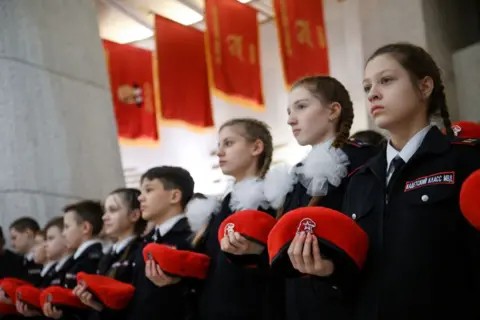
A recent Oscar-winning documentary has exposed how Russia’s wartime messaging has seeped into primary schools, placing children at the center of an expanding state-led patriotic program.
Footage from a provincial town in the Urals, filmed by school events organiser Pavel Talankin, shows pupils taking part in flag ceremonies, scripted lessons and other activities that promote a government-approved interpretation of recent events.
Parents like Nina in Moscow report feeling torn.
When her seven-year-old was asked to memorise a poem praising the military, Nina feared it crossed a line, yet her daughter loved the teacher, classmates and the sense of belonging the activities provided.
Another parent, Marina, shares that she opposes the invasion but avoids discussing politics at home because a child’s offhand remark could attract attention.
Many families prefer not to air dissent where it might isolate a child or bring trouble.
Therapist Anastasia Rubtsova advises parents to emphasise universal values—such as respecting human life and seeking peaceful solutions—rather than confronting school narratives head-on.
She warns that children must live with their peers and that overt parental opposition can create social friction.
Research shows young children are especially open to messages from authority figures.
Emily Willoughby, a behavioural genetics researcher, says family influence often shapes long-term attitudes when parents actively disagree with institutional messages.
But when the state tightly controls information and limits alternative viewpoints, outcomes become less certain.
Implementation of these patriotic directives varies widely.
Some schools adopt them enthusiastically, others water them down, and some teachers quietly resist.
In classrooms shown in the film, children receive flags and are told the official line about why the country is at war.
The lessons—often presented as guided discussions—are widely criticised by teenagers who say they are dull and one-way.
Fourteen-year-old Maia from St Petersburg says pupils mostly listen and leave without real debate, and that public neutrality has become the norm among her peers.
Analysts note that compulsory displays of loyalty serve a political purpose beyond education.
Paul Goode, a scholar of Russian studies, argues these rituals reinforce the state’s reach and remind citizens of the regime’s dominance.
Policy changes have also made it easier for young people leaving school to join the military, with financial incentives and recruitment drives encouraging enlistment.
At the same time, the education ministry has proposed lists of state-approved toys and games for nurseries to promote traditional values.
The documentary and interviews with families underline a central tension: children are being encouraged to accept a single narrative at school, while some parents try to nurture different beliefs at home.
How those influences balance out will depend on each child’s wider social environment and the availability of outside perspectives.