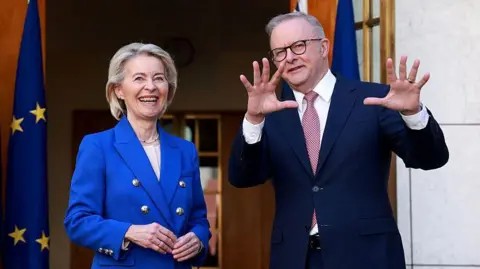
After eight years of talks, Australia and the European Union have finalized a wide-ranging free trade agreement in Canberra valued at roughly A$10 billion.
The pact removes almost all customs duties between the two sides and also deepens cooperation on defence, supply-chain resilience and critical minerals — steps officials said are designed to withstand growing global uncertainty.
Tariffs on many Australian agricultural exports will be scrapped, including wine, fruit, vegetables, olive oil, seafood, most dairy products and grains such as wheat and barley.
The Australian government estimates local winemakers will save about A$37 million under the deal, while shoppers in Australia should see lower prices on European wine, spirits, biscuits, chocolates and pasta.
The agreement also settles sensitive food-name issues: Australian-made sparkling wine can continue to be labeled prosecco domestically, but export use of that name will be phased out over ten years.
Some traditional European product names like parmesan will remain usable in Australia, while others such as feta face transitional limits.
Meat export rules proved contentious.
The EU quota for Australian beef will rise sharply over the next decade to around 30,000 tonnes annually, up from just over 3,300 tonnes, but Australian producers had been aiming for a higher allocation and have voiced disappointment.
European farm groups also criticised the concessions, saying additional import access stacks pressure onto a sector already affected by earlier trade deals.
By contrast, European carmakers welcomed improved market access.
Beyond commerce, the deal includes a security and defence dimension: enhanced collaboration in defence industry projects, counter-terrorism, space and maritime security is now on the agenda.
The pact also paves the way for joint projects on critical minerals such as lithium and tungsten, signalling closer industrial ties at a time when access to strategic raw materials is geopolitically sensitive.
Brussels has been moving to broaden its global trade relationships amid shifting geopolitical dynamics.
The Australia agreement follows other recent EU moves to diversify ties, including a breakthrough understanding with India and the stalled Mercosur pact in Europe’s parliament.
Both Canberra and Brussels described the accord as a long-term, mutually beneficial partnership, emphasising resilience and trust as central goals as global trade patterns shift.