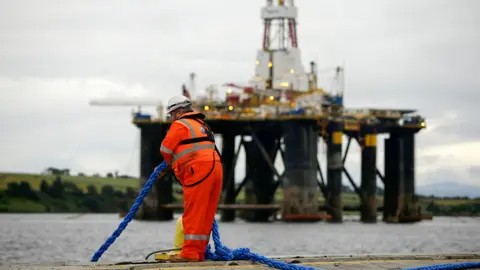
A major industry group is warning the UK it must boost domestic oil and gas production to avoid growing dependence on imported fuel as global tensions push prices higher.
Offshore Energies UK (OEUK) says the government should rethink its ban on new North Sea exploration licences, arguing that Britain risks exposure to supply shocks if more home-grown output is not allowed.
Energy markets have tightened sharply since fighting in the Middle East escalated and shipping through the Strait of Hormuz was disrupted, sending crude prices up by more than 30%.
The Labour government has defended its approach, saying issuing new exploration permits would not deliver energy security or directly cut household bills because oil and gas trade on global markets that set prices.
Energy Secretary Ed Miliband has argued the crisis highlights the need for domestically controlled, low-carbon power.
OEUK responds that expanding renewables and sustaining oil and gas production are not mutually exclusive.
In a new report the trade body notes oil and gas still account for roughly three quarters of current UK energy use and predicts they will supply around one-fifth of demand by 2050.
It warns domestic output is falling even as demand pressures rise.
OEUK chief executive David Whitehouse said the recent market volatility shows how quickly supplies can be diverted away from the UK when other buyers pay more, and called for a rapid increase in secure domestic production.
The group is pressing for a formal review of last year’s licence ban and wants the government to end the Energy Profits Levy in 2026, replacing it with a price-triggered levy capped at about 35%.
OEUK says the change could unlock about £50bn of new investment in North Sea projects.
The opposition Conservatives plan to use a parliamentary debate to urge scrapping the windfall tax and lifting the licence ban.
They also want fresh approvals for the Rosebank and Jackdaw fields after a Scottish court ordered further environmental assessment.
Critics remain unconvinced that more drilling will help households.
Oxford researchers found that even generous extraction scenarios would deliver far smaller bill reductions than accelerating the shift to renewables.
Environmental groups argue the industry is campaigning for tax cuts that would primarily boost company profits rather than lower prices.
The debate pits immediate energy-security arguments against longer-term climate targets and questions over who benefits from North Sea resources.
With prices and geopolitics in flux, ministers face a difficult balancing act between supply, climate commitments and consumers’ costs.