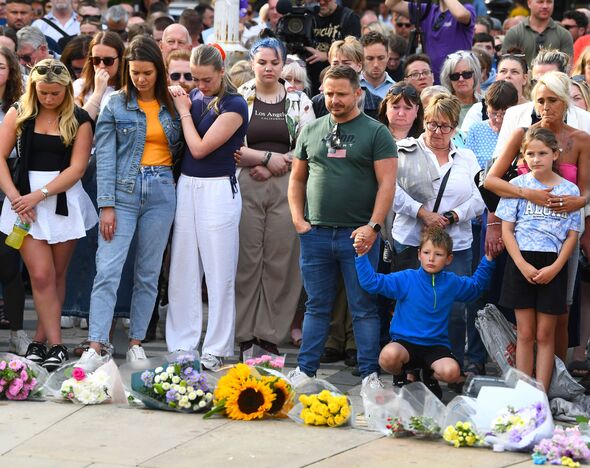

The horrific murder of three young girls in Southport “could and should” have been prevented, an official inquiry concluded. Agencies that were supposed to protect the public, including the police, missed “a number of opportunities” to stop killer Axel Rudakubana before the killing of Alice da Silva Aguiar, nine, Bebe King, six, and Elsie Dot Stancombe, seven.
A damning report found Rudakubana “clearly revealed the extreme danger that he presented to others” as early as December 2019, but there was “a fundamental failure” to take responsibility for him. Inquiry chair Sir Adrian Fulford, who referred to Rudakubana by his initials, said: “This failure lies at the heart of why AR was able to mount the attack, despite so many warning signs of his capacity for fatal violence.”
Publishing his 260-page report at Liverpool town hall, he warned: “If appropriate arrangements and reasonable resources had been in place to address the risk that AR posed to others from December 2019 onwards, it is highly likely that the tragedy of 29 July 2024 would not have occurred.” Rudakubana had been in contact with organisations including Lancashire Police, social services and the Prevent anti-terror programme. But agencies refused to “take ownership” of the case, and it was passed from one to another “in an inappropriate merry-go-round.”
Read more: Southport Inquiry highlights 5 major failings as Rudakubana's parents criticised
Read more: Southport killer Axel Rudakubana's supervision was 'downgraded before attack'
As a result, he was allowed to build up an arsenal of weapons, including the ingredients to create chemical weapon ricin, while viewing “vile and disturbing imagery” online which encouraged violence.
The killer, then aged 17, went on to carry out his knife attack on a Taylor Swift-themed dance workshop in 2024, where he also attempted to murder eight other children as well as class instructor Leanne Lucas and businessman John Hayes.
Chris Walker, the solicitor representing bereaved families of the three girls, said: “The Southport murders were not only predictable, they were preventable.
“For our families, this has always been about honouring their girls and ensuring no one else endures what they face every day.
“The chair’s conclusion that this atrocity would not have occurred had agencies taken ownership of the escalating risk is stark ... crucially, the inquiry finds that the attack would have been prevented had agencies acted to a competent level.”
Sir Adrian was also deeply critical of Rudakubana’s parents, Alphonse Rudakubana and Laetitia Muzayire, saying they were “too ready to excuse and defend” their son’s actions. But the former high court judge said their “challenging” behaviour should have provided a further warning to the authorities that Rudakubana “was not being effectively parented”.
Some agencies saw it as their role to protect Rudakubana rather than the public, and there was “a repeated tendency on the part of multiple agencies to excuse AR’s behaviour” because he was autistic.
The danger posed by Rudakubana was clear as early as 2019, when he contacted Childline saying he wanted to kill a fellow pupil. Childline informed the police, and he was expelled after admitting he had previously taken a knife to school.
He returned to his old school in December armed with a hockey stick, modified for use as a weapon, and a knife. Chased by school staff, he attacked a random pupil before being arrested.
This should have been “a watershed event”, the inquiry found. The report said: “It put beyond doubt that AR was motivated by an enduring desire to inflict severe harm on and possibly kill another pupil ... taken with the other information available at the time, this should have led all agencies involved to a conclusion that AR posed a high risk of harm to others.”
Instead, the authorities took little interest as Rudakubana ordered an arsenal of weapons from online retailers, including a bow and arrows and machetes, and even bought ingredients and equipment from Amazon that could be used to create ricin.
There was another warning in March 2022, when Rudakubana went missing with a kitchen knife. Police found him on a bus with the weapon, and he told officers that he intended to stab someone.
But the inquiry said: “Interaction between AR and the relevant organisations became, at best, something of a token” - until the horrific murders took place.
Sir Adrian also highlighted the role of the internet in encouraging the killer’s violent tendencies. He said: “I have no hesitation in concluding that the degrading, violent and misogynistic material which AR was viewing online contributed to – and ‘fed’ – his already unhealthy fascination with violence.”
A second phase of the investigation will now examine arrangements for identifying and managing the risk posed by people who are fixated with extreme violence.
Prime Minister Sir Keir Starmer described the Southport Inquiry report as “harrowing”, as he pledged his “total determination to make the changes across the entire state that is so clearly necessary to honour the victims”. Home Secretary Shabana Mahmood said the Government will provide a full response to Sir Adrian’s report “this summer”.
Police last night issued an apology and Lancashire Constabulary Chief Constable Sacha Hatchett said Rudakubana should have been arrested after the bus incident in 2022.
She said: “We did not adequately assess the risk he posed to others. I am extremely sorry for this.”