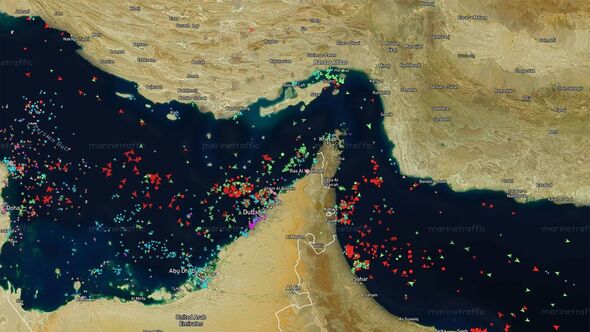

U.S. Central Command is poised to enforce a blockade on all maritime traffic entering and leaving Iranian ports, covering Iranian ports on both the Arabian Gulf and the Gulf of Oman.
The official statement issued by U.S. Central Command on X on Sunday afternoon reads as follows:
"U.S. Central Command (CENTCOM) forces will begin implementing a blockade of all maritime traffic entering and exiting Iranian ports on April 13 at 10 a.m. EDT, in accordance with the President's proclamation.
"The blockade will be enforced impartially against vessels of all nations entering or departing Iranian ports and coastal areas, including all Iranian ports on the Arabian Gulf and Gulf of Oman. CENTCOM forces will not impede freedom of navigation for vessels transiting the Strait of Hormuz to and from non-Iranian ports.
"Additional information will be provided to commercial mariners through a formal notice prior to the start of the blockade. All mariners are advised to monitor Notice to Mariners broadcasts and contact U.S. naval forces on bridge-to-bridge channel 16 when operating in the Gulf of Oman and Strait of Hormuz approaches."
Read more: Trump plots Iran strikes after peace talks collapse
Read more: Donald Trump was blindsided by Melania's bombshell Epstein address
A U.S. blockade could further unsettle global energy markets. "It's going to be all or none, and that's the way it is," Trump told Fox News.
Trump announced on social media that he had instructed the Navy to "seek and interdict every vessel in International Waters that has paid a toll to Iran. No one who pays an illegal toll will have safe passage on the high seas."
He indicated that other nations would be involved, though declined to name them.
Iran's Revolutionary Guard subsequently declared that the strait remained under Iran's "full control" and was open to non-military vessels, while military ones would receive a "forceful response," according to two semi-official Iranian news agencies.

During the 21-hour talks, the U.S. military confirmed that two destroyers had passed through the strait ahead of mine-clearing operations, marking a first since the war began.
Trump's ambition to deploy the Navy to blockade the strait is wholly unrealistic and he will be forced to make concessions with Iran, according to Andreas Krieg, a senior lecturer in security studies at Kings College London.
"There isn't any tool in the toolbox in terms of the military lever that he could use to get his way," Krieg said.
Trump maintained that Tehran's nuclear ambitions lay at the heart of the talks' breakdown. Speaking to Fox News, he once again threatened to target civilian infrastructure.
Parliament speaker Mohammad Bagher Qalibaf, who headed Iran's delegation, addressed Trump directly upon his return to Iran: "If you fight, we will fight."