
Hero Second World War soldier Mervyn Kersh said he will never give up fighting for what is right - even at the age of 101.
The proud Jewish D-Day hero, who stormed Nazi-held France in 1944 and later helped liberate Bergen-Belsen concentration camp, remains appalled at the scourge of rising antisemitism.
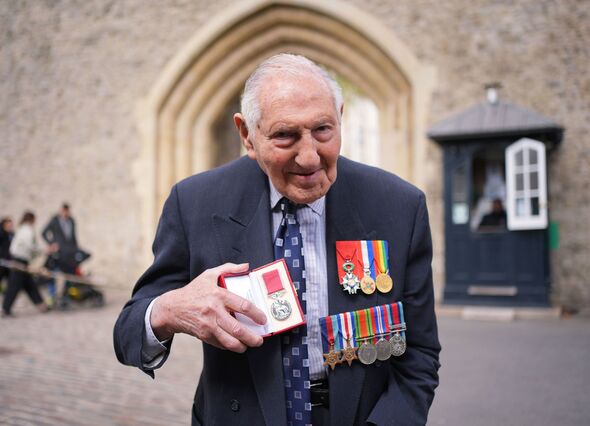
Today Mervyn received a British Empire Medal awarded by King Charles in the New Year’s Honours.
It was in recognition of Holocaust education and his tireless commitment to teaching generations where racism and hate eventually leads.
Mervyn proudly pinned his latest gong to his gleaming collection and said this one means the most because combatting hate is more relevant now than at any time in the eight decades since the end of the war.
He told the Express: “I was over the moon when I was awarded the Legion d’Honneur in 2015 but, as my daughter Lynne reminds me, that medal is France’s highest award to those who assisted in the liberation of France during the Second World War.
“The British Empire Medal is awarded to individuals in recognition for hands-on service to people who have made a significant difference to their local area in a voluntary capacity.
“In my case this is for all the talks I have given to schoolchildren of all ages, to adults at various clubs and events, and for the many articles and books I have written over the past 80 years since the war.
“My message has always been fervent and always the same – the importance isn’t to win wars but to avoid them by being too strong for anyone to dare attack, and it is as important and as vital today as it was back in the 1930s.

“Antisemitism reveals diseased minds and corrupt societies, and it eventually leads to the Holocaust, which we must not only learn about but never, ever forget so that it can never happen anywhere again.
“I am extremely happy that my efforts, which I've always found rewarding and enjoyable over these 80 years, have been appreciated and I am honoured to receive this medal.”
In June 1944 Mervyn, from Cockfosters, north London, landed on Gold Beach with the Royal Army Ordnance Corps as part of the Allied invasion of Nazi-occupied France.
His role was to ensure a steady flow of vehicles supplying British Army units fighting their way to Berlin.
But it was at Bergen-Belsen, where he witnessed apocalyptic scenes of human suffering, that a lifelong determination to fight prejudice wherever it rears its head was formed.
Initially a POW camp for Allied soldiers it became a notorious Nazi concentration camp in 1943.
It was liberated by British troops who found tens of thousands of starving prisoners and thousands of unburied bodies on April 15, 1945. It is estimated 70,000 Jews died there.
Mervyn was greeted with the sight of typhus-ridden and skeletal prisoners clinging to life dressed in striped prison uniforms. It is a memory that still haunts him.
He said: “I could almost say [going to war] was a crusade, if that’s not the wrong word. To me, this had a purpose. It wasn’t just a game or passing the time it was to put the Germans out of action as long as possible.
“We knew what was happening. [We] didn’t know the extent of it, but we knew they had gas chambers. They were killing people, shooting them, hanging them.”

He picked up his medal from Sir Kenneth Olisa, the Lord-Lieutenant of Greater London, on behalf of King Charles.
He was escorted to the ceremony at The Tower of London by the Taxi Charity for Military Veterans, accompanied by his daughter.
In June he will make a pilgrimage to France with the charity to commemorate the 82nd anniversary of D-Day.
Mervyn and his chums will return, as they have done every year, to pay their respects at the British Normandy Memorial, the edifice overlooking Gold Beach where he waded ashore, and which records the names of 22,442 soldiers who fell on June 6, 1944 and the three-month Battle of Normandy that followed.
Mervyn said his war was nearly over before it started with his religion almost leading to his arrest and imprisonment.
Before he was due to sail to Normandy, Private Kersh was ordered to see his commanding officer.
He demanded an explanation as to why the 19-year-old soldier was refusing to eat Army rations of tinned beef and vegetables and only surviving on canned peaches. His superiors suspected he was trying to dodge the war by making himself too frail to fight for the liberation of Europe.
He recalled: “I said that was the last thing I wanted to do. I’m Jewish. I didn’t eat anything that wasn’t kosher as far as I could help it.” The charges were dropped.
Mervyn, an ambassador for the Normandy Memorial Trust, said he "absolutely" sees comparisons between now and the period just before the Second World War and urged the Government to act.
He said: "The top budget should be defence. Defence must come first, second, third, fourth and fifth, because only if you're strong, you won't be attacked.”
And he compared today's leaders to weak Neville Chamberlain, whose 1930s appeasement of Hitler failed, saying: "They think they've just got to hope and make speeches.
"We've got to either have another leader who's more aggressive, I don't mean start a war, but be aggressive. We've got to defend, that's the first concern."
Dick Goowin, Vice President of the Taxi Charity for Military Veterans, said: “We are absolutely delighted for Mervyn. Being awarded a British Empire Medal for services to Holocaust education is fitting recognition of his tireless commitment to ensuring the lessons of history are never forgotten. We are incredibly proud to see his dedication and impact recognised in this way and we send him our warmest congratulations.”