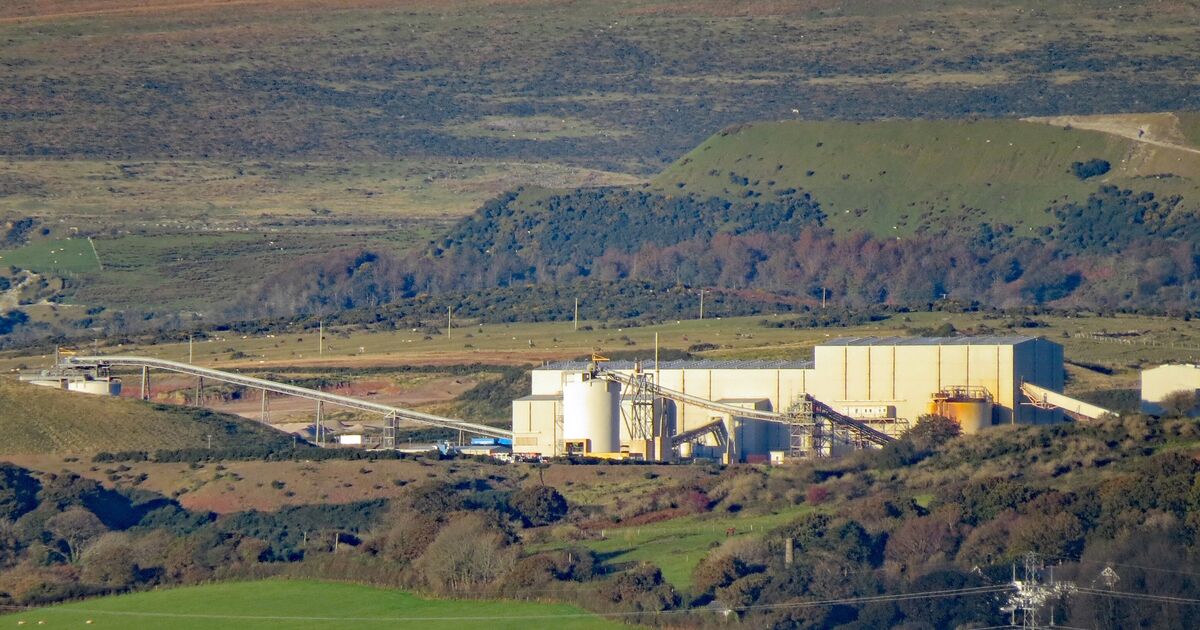

A Devon mine sitting atop one of the richest tungsten reserves on the planet is reportedly being readied for production, as demand for the metal surges on the back of wars in Ukraine and Iran.
Hemerdon, a site with roots going back to Victorian times, fed the Allied war effort twice during the twentieth century before a commercial revival attempt folded in 2018 after three years of operation. The money ran out. Now the Express understands a new company is betting the strategic moment has arrived to try again.
Tungsten West, which is listed in London, is said to be planning to start producing modest volumes at Hemerdon before the end of the year, scaling up to full output by 2027. When running at capacity, the mine is projected to yield around 3,300 tonnes of tungsten concentrate a year — roughly a fifth of all tungsten produced outside Chinese jurisdiction, and enough to satisfy approximately a third of worldwide defence demand on its own.
Few materials are as coveted by weapons designers. Tungsten withstands temperatures that would melt virtually anything else — its threshold sits at 3,422C — and its density makes it ideal for punching through hardened targets. It turns up in the tips of hypersonic missiles, inside armour-piercing ammunition, in the payloads of bombs built to penetrate buried bunkers, and in shells engineered to detonate above drone swarms.
Consumption accelerated dramatically when American and Gulf forces launched their campaign against Iran in late February, burning through stockpiles of interceptor missiles at a pace that sent buyers scrambling. The pressure had already been building. A year earlier, Beijing had moved to choke off tungsten exports reports The Telegraph — a decision that focused minds sharply in Western capitals, given that Chinese facilities account for four fifths of everything the world produces.
Nick Lawson, chief executive of investment group Ocean Wall, is reported to have said the consequences of that dependency were now impossible to ignore.
"Hemerdon is one of the world's great tungsten deposits and it sits in Devon," he said. "At a moment when Western supply chain vulnerability has become a strategic liability, Britain producing its own critical minerals is not an option, it is an obligation."
Jeff Court, chief executive of Tungsten West, reportedly said the appetite among potential customers had sharpened considerably as the risks of relying on a single dominant supplier became clearer.
"That is why they're now looking at how to diversify," he is understood to have said, describing Hemerdon as a "very significant" share of the non-Chinese market.
The bulk of the mine's output, Court said, would head to civilian industries — construction, transport, manufacturing and medicine — though he acknowledged the defence dimension was becoming harder to separate from the wider conversation.
"We're a very good hedge and a good way to achieve supply chain resilience and support a variety of sectors, including defence, for a number of Western economies," he said. "As you can imagine, there's a lot of people who were pretty keen for us to accelerate. So if we can accelerate and we can move faster, we'd like to bring forward production."
The Biden and Trump administrations have both pushed allies to break their dependence on Chinese mineral supply chains. Washington has been cutting deals to fund extraction and processing operations in friendly countries, with the aim of building a network Beijing cannot squeeze.
Lawson told reporters China's export restrictions had injected fresh urgency into that effort.
"When China controls 83pc of global supply and chooses to weaponise that position, the rest of the world has no good options," he said.
Devon is not the only county with skin in the game. In Cornwall, Strategic Minerals is reportedly advancing a separate tungsten project at the Redmoor site, a smaller operation that has drawn £1.5 million in public funding and is currently being assessed by engineers.
Hemerdon, meanwhile, is expected to run for around eleven years at full tilt, underpinning more than 300 long-term jobs and pumping hundreds of millions of pounds into the surrounding economy.