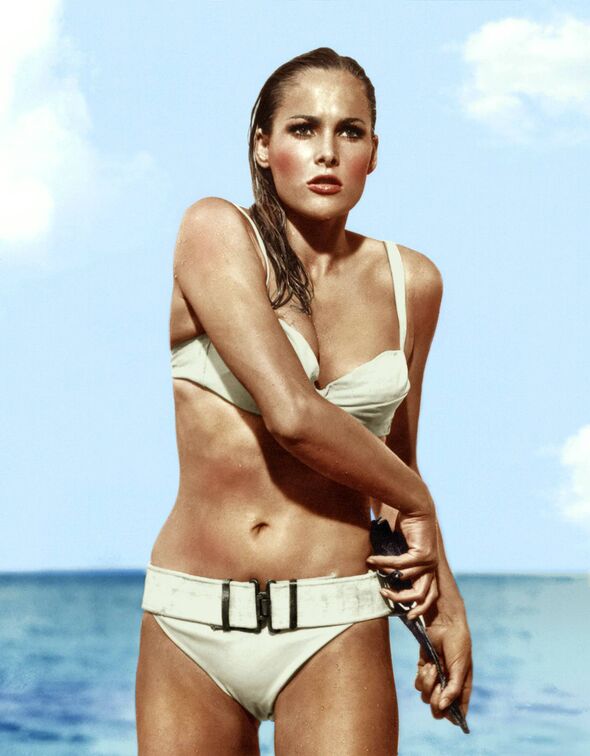

It was the pivotal moment that sparked a cinematic franchise, catapulted a global star into fame - and would forever characterise Ursula Andress. Today, over six decades later, millions can instantly recall the striking 25 year old emerging shimmering from the sea in a white bikini, a knife fastened to her hip, in the inaugural James Bond film. The iconic scene from 1962's Dr No - subsequently voted the sexiest in film history - was so captivating it nearly eclipsed Sean Connery's 007, transforming the unknown Swiss actress into an international sensation.
However, whilst Ursula, who celebrates her 90th birthday today, always recognised the remarkable success that single moment brought her, she also spent a lifetime attempting - unsuccessfully - to break free from it. The star, who once courted some of the world's most sought-after men, eventually retreated from the limelight and, for the past three decades, has lived as a virtual hermit. "That bikini made me into a success," Ursula confessed in a rare 2001 interview. "It gave me freedom, money, power." But it came with a price - leaving her perpetually defined by her breakout role. She reflected: "I was never really seen. They only saw the body. Sometimes I would arrive on set and I knew - this wasn't about making a film. It was about taking my clothes off."
Read more: James Bond odds rocked as surprise new contender wows at Oscars
Read more: 'Masterpiece’ James Bond movie named the best of all 27 films - ‘Bond peaked’

Born in 1936 in Bern, Switzerland, to a Swiss mother and German diplomat father, Ursula's journey to fame commenced in spectacular circumstances. Aged 17, when a French film crew visited her boarding school, she embarked on an affair with its 35-year-old lead actor, Daniel Gélin.
She absconded with him to Paris and subsequently Rome, even dodging Interpol officers dispatched by her parents to retrieve her. After securing employment as a model, she featured in several modest Italian productions, before one of Gélin's acquaintances, Marlon Brando, encouraged her to pursue opportunities in Hollywood, reports the Mirror.
Stardom did not materialise immediately. Arriving in 1955, for seven years parts remained scarce - partially owing to her unwillingness to master English. Instead, she garnered attention for her private affairs, including a relationship with James Dean shortly before his fatal accident, and her marriage to actor John Derek.
Everything transformed in 1962, when she secured the role of shell diver Honey Ryder in Dr No - though her pronounced accent necessitated her dialogue being dubbed by German actress Nikki van der Zyl. In the now-iconic sequence, Ursula rises from the ocean clutching a shell, asking Bond: "What are you doing here? Are you looking for shells?" - to which Sean Connery replies: "No, just looking."

At the time, numerous observers anticipated the film would fail. Ursula recalled: "It was a very small budget production and I agreed to do it thinking not many people would see it. I didn't know Sean and I thought it would be my first film - and maybe my last."
Instead, that solitary moment propelled her career and ultimately rescued the production. Chris Blackwell, a production assistant on Dr No, subsequently remembered how the picture had resembled "a low-budget flop" until the beach material arrived. Witnessing Ursula emerge from the ocean transformed everything. "It was electrifying," he said. "We suddenly felt, 'Gosh, we've got a movie.'" He also remembered how James Bond creator Ian Fleming nearly spoiled a take of the iconic beach scene.
Leading two companions on a stroll along the shoreline, Fleming almost stepped directly into shot - until director Terence Young shouted at them to "Lie down!" The trio were swiftly ushered behind a sand dune, where they stayed - overlooked - for almost an hour, before anyone remembered to summon them back.
Ursula secured the Golden Globe for New Star of the Year in 1964 for her Dr No performance - which also helped establish the bikini, then still prohibited in numerous countries, as a worldwide fashion essential.

The following year, she appeared opposite Elvis Presley in Fun in Acapulco, and alongside Frank Sinatra, Dean Martin and Anita Ekberg in 4 for Texas. She would later feature in films including 1965's She, 1979's The Fifth Musketeer and Clash of the Titans in 1981.
Yet, by her own acknowledgement, Ursula was regarded less as a performer and more as a screen goddess, with filmmakers concentrating on her appearance and reviewers commenting on her physique rather than her acting ability. Initially, she welcomed it - establishing herself as one of the most audacious stars of the 1960s, unashamedly sensual and determinedly independent.
When questioned about why she appeared nude for Playboy seven times during an era when fellow actresses shunned it, she responded plainly: "Because I'm beautiful."
However, opportunities diminished when she grew weary of being selected for her appearance rather than her abilities. She declined television projects, spurned profitable contracts and even pursued legal proceedings against a studio for unauthorising her image.
By the late 1970s, Hollywood had predominantly abandoned her. When, in 1980, she became a mother at 44 to son Dimitri with actor Harry Hamlin, she departed the limelight, opting instead to raise him well away from the scrutiny of celebrity. She reflected: "Dimitri is the only thing I've done that lasted. He is my masterpiece."
Now, as she reaches 90, acquaintances say the woman formerly regarded as the most beautiful in the world seldom ventures from her residence - splitting her time between her villa in Rome and a chalet in the Swiss Alps. Diagnosed with osteoporosis, she experiences mobility difficulties. She reportedly stated, "I don't want people to see me like this. I want them to remember who I was."