 Family handout
A father has confirmed his 18-year-old daughter was one of two young people to have died in a meningitis outbreak in Kent, saying the family are "beyond devastated and they have no words to express their loss".
Juliette, who was a sixth form pupil at Queen Elizabeth's Grammar School in Faversham, died on Saturday from the infection.
A 21-year-old student at the University of Kent has also died, while 11 others were taken to hospital and hundreds of students have been queuing for antibiotics.
Three schools and the university have confirmed cases, with in-person exams and assessments cancelled at the university.
More than 30,000 people across Canterbury have been contacted by the UK Health Security Agency (UKHSA), which said the outbreak was "particularly large" and "unprecedented in recent years".
Juliette's head teacher, Amelia McIlroy, said she was "a genuinely caring and attentive listener, a true friend who listened with warmth, respect and sincere interest to her peers and to our staff".
"In short, she was a lovely girl," she added.
 PA Media
In the immediate aftermath of the outbreak, health professionals were seen at the University of Kent, transferring people to hospital while wearing protective clothing.
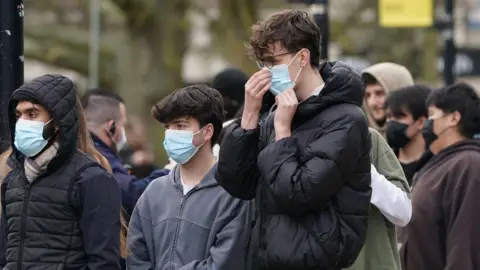
Throughout the day, students in face masks and members of the public have been lining up on campus to receive precautionary antibiotics.
The university said it would resume providing antibiotics at 09:00 GMT on Tuesday.
It also said the campus would remain open, despite all scheduled assessments for the next few days being cancelled.
Isabel Kenny, 21, was one of the hundreds of students queuing up.
The fourth year said she heard about the outbreak on the news before emails from the university started coming in. Her friends then started texting in group chats.
"Everyone was getting quite nervous really," said Kenny, who added that she had seen several of her peers packing up and heading home.
"Everybody is going home, I saw so many students with suitcases going towards the train station."
The UKHSA has so far said it is aware of 13 cases with signs and symptoms of meningitis from Friday to Sunday in the Canterbury area.
A spokeswoman said: "We can confirm that UKHSA has worked with the University of Kent to provide advice letters to all 16,000 students, advising on recent cases, signs and symptoms, how to obtain antibiotics, and what to do if they feel unwell."
Not all 16,000 students at the university will be given antibiotics.
The outbreak is thought to be linked to a nightclub event in Canterbury.
Club Chemistry owner Louise Jones-Roberts said the UKHSA had informed staff that somebody who was in the club had "since been diagnosed with meningitis".
She said the agency had asked if the club had methods for tracing people, but there were hurdles.
"We have an ID scanner but that is more of a security measure," she said. "It takes pictures of some driving licences, ID cards and so on."
Jones-Roberts said the club would stay closed until further advice from the UKHSA, adding: "I can't imagine what the families are going through. Meningitis affects healthy, young people and this is devastating."
Anyone who visited the club on March 5, 6 or 7 should "come forward for preventative antibiotic treatment as a precautionary measure", the UKHSA said.
The number of confirmed cases remains at 13, according to its latest update.

On Monday, it was confirmed a Year 13 pupil from the Simon Langton Grammar School for Boys in Canterbury and a pupil from Norton Knatchbull School, in Ashford, were among those in hospital.
Trish Mannes, UKHSA regional deputy director for the South East, urged people to be aware of symptoms and to act fast.
"It's essential that students and staff are alert to the signs and symptoms of meningococcal meningitis and septicaemia, which can include a fever, headache, rapid breathing, drowsiness, shivering, vomiting and cold hands and feet," she said.
"Septicaemia can also cause a characteristic rash that does not fade when pressed against a glass.
"Students are particularly at risk of missing the early warning signs of meningitis because they can be easily confused with other illnesses such as a bad cold, flu or even a hangover."
Anyone becoming unwell with symptoms of meningitis and septicaemia is urged to go to their closest A&E department or call 999.
The specific strain of meningitis connected to the outbreak has not yet been identified.
Meningitis can be spread to others in spit or saliva through coughs and sneezes, kissing and sharing utensils.
Two vaccines protect against the main causes of meningitis and septicaemia.
The MenACWY vaccine offers protection against four types of bacteria that can cause meningitis - meningococcal groups A, C, W and Y - and is offered to teenagers aged 14 years old.
The MenB vaccine helps protect against meningococcal group B bacteria and is recommended for babies aged eight weeks, followed by a second dose at 12 weeks and a booster at one year.
Follow BBC Kent on Facebook, on X, and on Instagram. Send your story ideas to southeasttoday@bbc.co.uk or WhatsApp us on 08081 002250.