 Warsaw court
The trial has opened in the Polish capital, Warsaw, of five men suspected of involvement in sending parcels containing a liquid high explosive to the UK and Poland on behalf of Russian intelligence.
The men, who are Ukrainian and Russian citizens, have been charged with participating in an act of terrorism in the summer of 2024 when three of the parcels ignited in transit.
One burst into flames just before it was loaded on to a DHL cargo flight to the UK.
The parcel plot is one of a wave of sabotage attacks across Europe which officials have linked to Russia since the full-scale invasion of Ukraine.
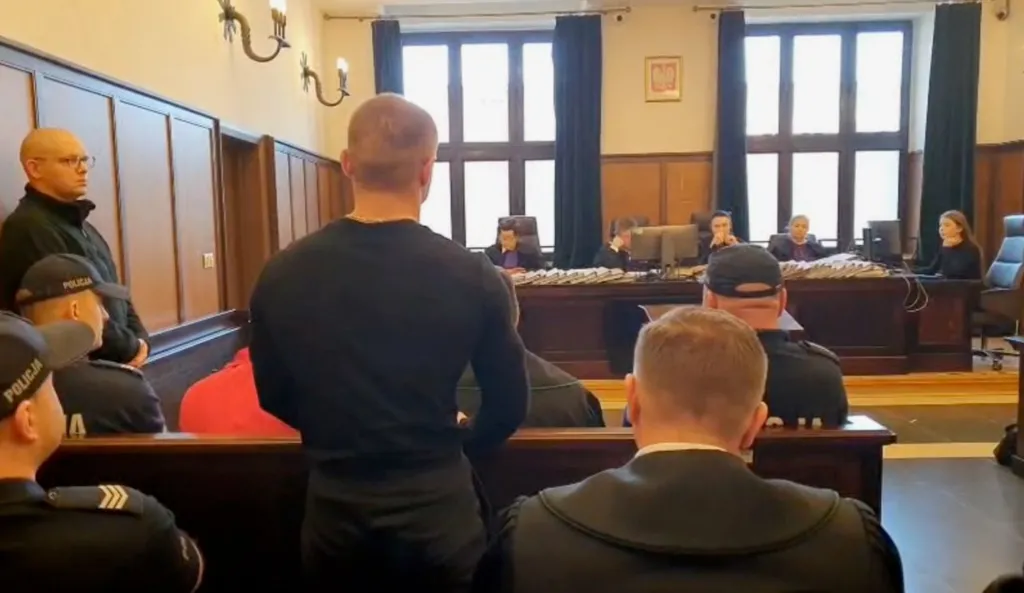
Four of the accused were brought to court on Friday morning wearing bright orange prison overalls, with chains binding their ankles and wrists.
Inside the small courtroom, they all then sat with a police guard on either side as the prosecutor gave a detailed account of the alleged plot. His words were translated into Russian for the defendants.
The men are said to have played different roles in the operation, co-ordinated over the messaging app Telegram by handlers based in Russia.
The incendiary devices were made with a liquid explosive hidden in tubes of face cream, and ignition mechanisms buried inside massage cushions. The devices evaded all the normal security checks.
The prosecutor said the group's aim had been to cause a catastrophe by starting a fire on board a plane, and to "intimidate large numbers of people".
At this first hearing, Ukrainian national Vladislav D., as he is referred to in Poland, was the only suspect called to speak. Others sat smirking and chatting over their guards throughout the hearing.
Vladislav D admitted to handing four boxes containing the cushions and cosmetics to an "unknown man" in Vilnius, Lithuania, but he denied working for Russian intelligence.
"I did not act in the interests of Russia, or against Poland and others. I do not admit that I carried out an act of sabotage," he told the court, then declined to answer any questions.
But the prosecution then read out his previous statements in which he gave a detailed account of activating the ignition devices, before passing them on for posting.
At the time, Vladislav D. claimed he was reluctant, but had been threatened by his handler, nicknamed "Warrior", who appeared to have information about his relatives in Ukraine.
Twenty-two suspects have been arrested in total in both Poland and Lithuania from where the parcels were sent via DHL and DPD courier services.
The man paid to send them, Alexander Suranovas, has told the BBC he had no idea there were explosives inside. He also revealed that when he was arrested, he'd already been hired to send "three or four" more parcels every month.
His own trial, along with four other suspects in Lithuania, will begin next month. The trial in Warsaw will continue in mid-April.