 EPA/Shutterstock
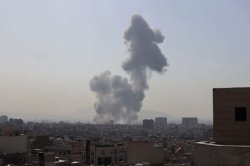
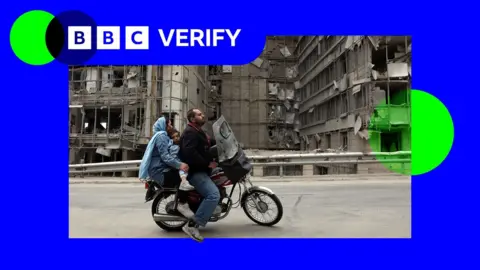
Schools, a hospital and historic landmarks have been severely damaged since US and Israeli strikes on Iran began on Saturday, satellite images and verified videos show, as the number of reported civilian casualties grows.
According to the US-based Human Rights Activists News Agency (HRANA) 1,168 civilians have been killed, including 194 children.
Because of the almost total internet blackout imposed by the authorities, it has been very difficult to speak to people inside Iran, and video footage has been difficult to access.
However, Tehran residents who have been able to connect to the internet say that Thursday night was the most intense night of bombings in the capital and the most frightening by far, with many staying awake all night due to the intensity of strikes.
One described the night as "hell on earth", and another as "a scene from a dystopian film".
BBC Verify has documented damage to a hospital, sporting centres, a Unesco world heritage site and two schools - one of which saw 168 people killed on Saturday morning, according to Iranian officials.
US Defence Secretary Pete Hegseth said the blast at the school in the southern city of Minab was under investigation and insisted US forces "never target civilian targets".
Verified images also show damage to a separate school building in Urmia, northwestern Iran.
Among the other buildings damaged since strikes began was the Gandhi Hospital in the Iranian capital Tehran on Sunday.
Verified video of the hospital showed extensive damage to the building, with debris and glass falling as civilians watched on.
A spokesperson for Iran's foreign ministry said such attacks were a "blatant war crime", while World Health Organisation chief Dr Tedros Adhanom Ghebreyesus said that the incident was "extremely worrying", adding that "health facilities are protected under international humanitarian law."
Footage taken in the immediate aftermath of the attack show the area littered with debris and patients - including a baby in an incubator - being moved out of the hospital.
Mohammad Raeiszadeh, the head of Iran's Medical Council, told state media that the hospital's in-vitro (IVF) fertilisation department was destroyed by the strike.
Footage taken in the aftermath showed a fire blazing in what appeared to be a stairwell, while thick black plumes of smoke billowed from the upper floors. Images taken inside the building show windows blown out and damage to interior walls.
The IDF acknowledged there was "minor damage" to the hospital resulting from a strike on a nearby "military facility".
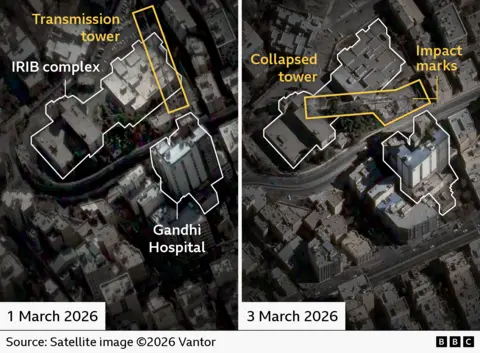
The hospital is opposite studios and offices owned by the state-run Islamic Republic of Iran Broadcasting (IRIB), which may have been the intended target of the strike.
Satellite imagery captured on 3 March shows a collapsed transmission tower on the IRIB site, as well as impact marks from the strike.
The front of the hospital, where video footage shows extensive damage, is not visible from the angle of the satellite image.
Janina Dill, an expert on international law at Oxford University, told BBC Verify that the status of media outlets as military targets during conflict can be contested, depending on how far one aligns propaganda with military strategy.
Describing the impact of the bombardment, one Tehran resident said that the constant "sound of ongoing blasts is fatiguing" and energy sapping.
Another described how destabilising the barrage has been for vulnerable Iranians. "My uncle has a mental illness. The poor man had convinced himself he was dead," they told the BBC.
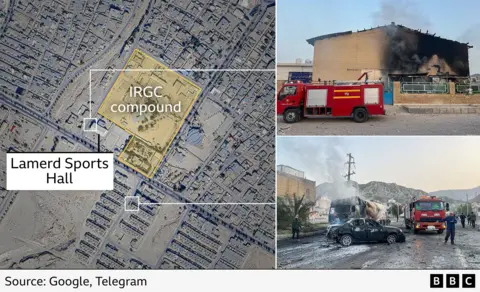
Elsewhere, in the southern coastal city of Lamerd, 20 people were killed after a blast at a sports hall on Saturday, according to Iranian state media. Footage filmed shortly afterwards showed heavy damage to the building, with scorch marks visible on the walls and smoke slowly rising from the exterior.
Other images show damage to buildings less than 300m away, suggesting more than one strike in the area.
An Islamic Revolutionary Guards Corps (IRGC) base is located in the town to the north of the hall, separated by a wall. No obvious damage has been observed to the base from the low-resolution satellite imagery we have available.
Neither the IDF or US military have responded to our questions on this incident.
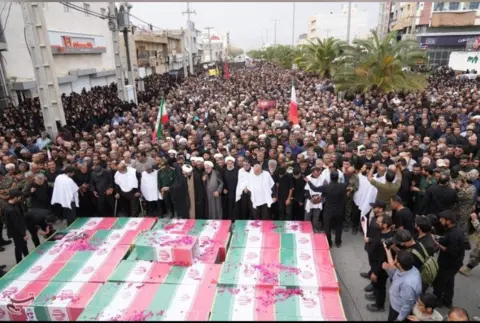
A mass funeral procession in the centre of the city on 2 March was shown in footage from the Tasnim news agency.
Hundreds were seen gathered, holding photos of the victims and the late Supreme Leader Ayatollah Ali Khamanei. The footage ends with a wide shot of mourners bowing their heads in front of a group of at least 18 coffins draped in the flag of the Islamic Republic of Iran.
 Tasnim
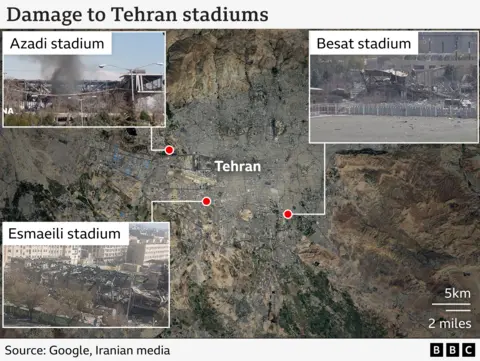
In Tehran, at least three sporting complexes have suffered major damage after strikes on Thursday. Among them is the 12,000-seat indoor stadium at the Azadi sports complex, which images show suffered near collapse.
The Israeli foreign ministry has said the building was being used as a "resting place" for Iranian forces.
Similar scenes of destruction were also evident at the Besat and Esmaeili stadiums, elsewhere in the city. We have approached the IDF for comment.
Commercial businesses, including shops and other stores, have also been struck across the country. Verified videos showed severe damage to a cafe in the centre of Tehran and the shop's distraught owner inspecting the ruins.
Damage to the cafe may have resulted from a strike on a police station directly across the road, which has been flattened.
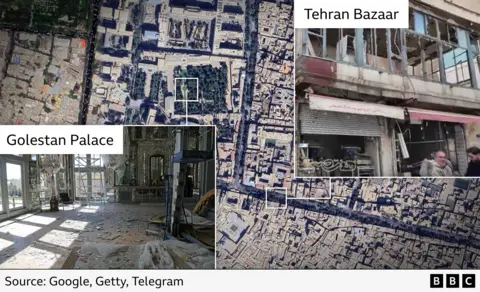
BBC Verify has also seen damage to an old bazaar in central Tehran's historic quarter as well as a palace listed as a Unesco world heritage site.
Verified footage from Monday shows shattered glass and scorched walls at the Grand Bazaar, a sprawling labyrinth of shops and stalls which has stood for centuries.
Images of the Golestan Palace, a former royal residence and one of the oldest buildings in the Iranian capital, reveal extensive damage.
Footage broadcast by Iranian state media on Tuesday has shattered glass littering the palace, with damage also visible to the parts of the exterior and solid wooden doors. The palace and the bazaar are both located near a complex housing Iran's judiciary and Supreme Court.
BBC Verify has confirmed videos and analysed satellite imagery showing the judicial complex had been damaged.
Unesco has said that the building suffered damage resulting from a strike on nearby Arg Square, where the judicial complex is located. It added that it had provided locations to all parties of sites on the World Heritage List and noted that "cultural property is protected under international law".
One Tehran local told the BBC that the city had been turned into a "ghost town" with empty streets and a lingering smell of gunpowder.
Another reflected on the recent violent crackdowns on countrywide protests, saying "the fear of war is better than the fear we have of the Islamic Republic"
Some 100,000 people fled Tehran in the first 48 hours of attacks, the UN's refugee agency said on Wednesday. It added that 1,000 to 2,000 vehicles were fleeing the city each day, mostly heading to the north of the country.
Dr Michael Becker, assistant professor of law at Trinity College Dublin, told BBC Verify that deliberate strikes on civilian sites are illegal under international law, unless those sites are being used for military purposes.
But he noted that there are limited exceptions to the rule, such as where a protected site is hit incidentally in the process of an attack on a military target.
He said that the exceptions can lead to "very weak constraints on military decision-making", and emphasised that if the harm inflicted on civilians is not proportionate to the military aim being pursued the strikes can remain illegal.
The full impact of the war on civilians remains unclear. An almost complete nationwide internet blackout remains in effect, according to the monitoring group Netblocks, meaning only limited information is emerging from Iran.
Isik Mater, the group's director of research, said there was no guarantee that a more complete picture would emerge even if the regime loosens connectivity restrictions.
"We've found that the anticipated huge rush of user generated content rarely emerges after Iran's shutdowns because people have either already found a way to transmit it when it mattered, or otherwise have ended up deleting it for safety or chosen to move on," she said.
"That's why real-time verification has become so important."
Additional reporting by Ghoncheh Habibiazad and Sarah Jalali.