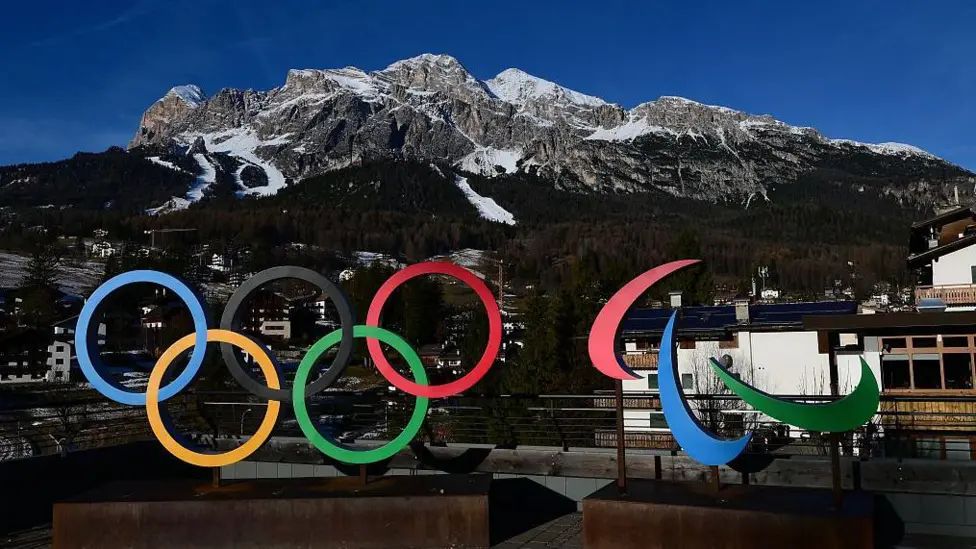
Russia's long exile from world sports events is about to end.
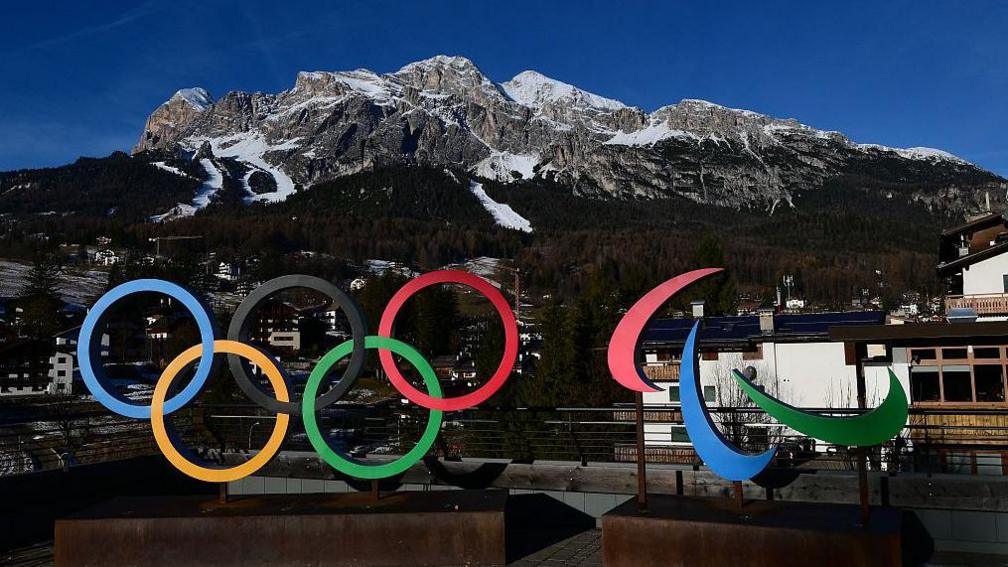
In a watershed moment, the Winter Paralympics will feature the country's athletes competing under their national flag at the event for the first time since 2014, despite its ongoing war with Ukraine.
So more than four years since Russia's full-scale invasion of its neighbour, what lies behind the move? Just how controversial is it? And could this lead to other attempts by sports bodies to reintegrate Russia? BBC Sport takes a closer look.
What happens when at the Winter Paralympics?
With the build-up to the Games already impacted by concerns over travel disruption because of the US-Israel war with Iran, tensions caused by another conflict also threaten to overshadow the event. In protest at the participation of a small number of athletes from Russia and its close ally Belarus, Ukrainian athletes are boycotting Friday's opening ceremony in Verona, along with a host of other nations.
Unlike at the recent Winter Olympics in Milan-Cortina, where their compatriots had to compete as neutrals, the six athletes from Russia and four from Belarus will be representing their countries, accompanied by their national flags, and potentially their anthems if they win gold medals.
Last year, the International Paralympic Committee (IPC) lifted its partial ban on athletes from the two countries competing at the Games.
However, the IPC does not govern the six sports contested at the Paralympics. The individual bodies - including the International Ski and Snowboard Federation (FIS) - refused to lift their own bans, but Russia and Belarus then won an appeal to the Court of Arbitration of Sport (Cas) against FIS.
As a result, athletes have been able to return to FIS competitions and the ten competitors have been awarded bipartite commission invitations in order to be in Milan-Cortina. With Russia subject to a blanket ban at the Paralympics in 2016, and then a partial ban at the following two editions as a result of a state-sponsored doping scandal, this will be the first time in 12 years that its flag will have featured at the Games.
The IPC has claimed that its original decision four years ago to ban Russian and Belarusian athletes from the 2022 Beijing Winter Paralympics was not due to the invasion of Ukraine per se, as that was not a breach of its rules. Rather, it says, they were sanctioned because Paralympic sport was being used to promote the military campaign, which was a breach. It has since said there is less evidence of such propaganda now.
At the time, having initially wanted to allow the athletes to compete as neutrals, the IPC then issued a full ban "in order to preserve the integrity of these Games and the safety of all participants", referencing the threat of a widespread boycott by other nations, and an "escalating" and "untenable" situation in the athletes' village.
In 2023, a partial suspension was introduced, allowing Russian and Belarusian athletes to take part in the Paris Paralympics, but only as neutrals.
This is the approach that the International Olympic Committee (IOC) has also applied in recent years, with Russian athletes having to compete as neutrals in the past four Games, firstly because of the doping scandal, and then as a result of the conflict with Ukraine. This has also been controversial however, with several Russian athletes approved to compete at the recent Olympics linked to activity supporting the war in Ukraine, according to evidence seen by BBC Sport.
The IPC says it is bound by the wishes of its members, a majority of whom voted against both a full or partial suspension of Russia and Belarus in September.
Some IPC members may have thought that it was wrong to mix sport and politics, and that it was unfair that athletes were being impacted by the actions of Russian President Vladimir Putin, especially when there is such an emphasis on inclusion in the Paralympics.
Others may have felt that it was inconsistent with the way other countries have since avoided sporting sanctions, despite alleged breaches of international law.
Very. Ukraine's president Volodymyr Zelensky has said the decision is "awful", while skeleton racer Vladyslav Heraskevych, who was disqualified from the Winter Olympics for wearing a helmet featuring images of athletes killed during Russia's invasion of his homeland, said it had made many of his country's Paralympians not want to be part of the Games at all.
On Wednesday, the IPC told BBC Sport that it had been informed that athletes from Ukraine, Czechia, Estonia, Latvia, Lithuania, Poland and Finland will boycott the opening ceremony. Germany's Paralympic Committee has also said that its team will feature in a pre-recorded broadcast section of the event, but will not be in the Parade of Nations in order to express solidarity with Ukraine.
Glenn Micallef, the European Commissioner for Sport, also said he would stay away, writing: "While Russia's war of aggression against Ukraine continues, I cannot support the reinstatement of national symbols, flags, anthems and uniforms that are inseparable from that conflict."
The governments of both the UK and hosts Italy are among those to have expressed their opposition to the IPC's decision.
A senior Russian sports official has accused the teams that are boycotting the opening ceremony of politicising the paralympic movement.
The IPC has said it is "disappointed" by teams staying away, and will be hoping the focus soon shifts to the performances of the 660 athletes competing in what is the 50th anniversary edition of the event.
IOC president Kirsty Coventry certainly suggested as much recently when she said: "Our game is sport. That means keeping sport a neutral ground. A place where every athlete can compete freely, without being held back by the politics or divisions of their governments."
Although she did not directly reference any particular country, the comments were widely interpreted to be hinting at a potential lifting of the partial Olympic ban on Russia and Belarus. Her words were welcomed warmly by Russian officials, with its sports minister suggesting the IOC could consider reinstatement in the spring.
So could Russia's Olympic exile be over by the time of the LA Games in 2028? Notably, Paulo Zampolli, US President Donald Trump's special representative for global partnerships, has appeared to support Russian participation at the Paralympics, reportedly saying that "sport is for all".
While some international sports organisations - such as World Athletics - have continued with blanket bans on Russian athletes, others have started to ease restrictions.
For instance, last year the International Judo Federation allowed them to compete under their national flag. And in December, the IOC advised sports governing bodies to let Russian youth athletes compete at international events again, under their own flag and national anthem.
In international football, there are also moves to reintegrate Russia. The country was unable to compete at the 2022 World Cup and Euro 2024, and will not be part of the 2026 World Cup. However, Fifa president Gianni Infantino recently said the governing body would consider lifting its ban, adding the sanction has "has not achieved anything" and "has just created more frustration and hatred".
Ukraine's opposition to such moves remains steadfast. According to its sports minister, Russia has killed more than 650 Ukrainian athletes and coaches, and damaged 814 sports facilities.
Global Athlete, an international athlete-led movement and campaign group, says: "Now is the time for sport to show leadership, not weakness.
"The global sporting community must stand together and demand that the IOC increase sanctions on Russia, not relax them.
"Russia should only be allowed back when the war ends and Russia withdraws from Ukraine. The peaceful nation of Ukraine needs support, not enablers."
The IPC may have paved the way for other global sports bodies to try to follow suit. At at a time of geopolitical upheaval, and more frequent demands for these organisations to take a stand against certain countries, the suspension of Russia could be seen as undermining their attempts to remain politically neutral.
But while the conflict with Ukraine continues, any moves by the IOC, Fifa or other sports bodies to do so will be highly controversial, and be met with considerable opposition, especially in Europe.

49 PerFlyer