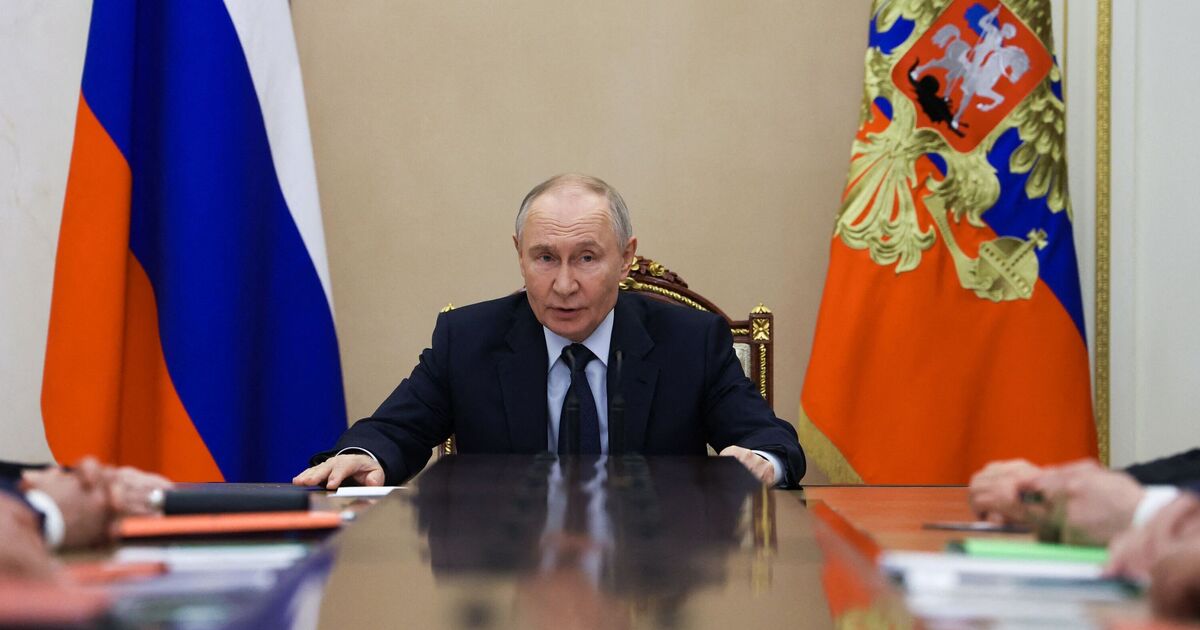

Vladimir Putin is restructuring Russia's internal security apparatus in a move analysts believe is aimed at shielding his regime from dangers lurking within his own ranks.
The development centres on two powerful state bodies being placed beneath the authority of Army General Valery Gerasimov, Chief of the General Staff and a close Putin ally, an arrangement that has set off alarm bells among those watching the Kremlin's internal dynamics.
A presidential decree has handed the Russian military authority over Rosgvardia, the country's national guard. Whispers are also circulating that the MChS could be wound down entirely, with staff absorbed into Rosgvardia's ranks.
Washington-based think-tank the Institute for the Study of War said the net effect would be to place both organisations firmly in Gerasimov's hands.
The restructuring is widely seen as a defensive move by Putin, stemming in large part from Rosgvardia's poor showing during the Wagner Group's armed rebellion in June 2023, when the national guard "failed to engage Wagner forces during the Wagner mutiny."
Prigozhin, who helmed the rebellion before dying in a suspicious plane crash widely attributed to Kremlin involvement, had dispatched his fighters northward from southern Russia in what he branded a "march for justice."
A report by the ISW said: "Putin created Rosgvardia in 2016 by subordinating some security forces from the Ministry of Internal Affairs (MVD) under his direct control.
"He likely deliberately vaguely defined Rosgvardia's responsibilities to grant him direct authority to control protests and to coup-proof his regime.
"Putin may have perceived Rosgvardia as an emerging threat to his regime, particularly after Rosgvardia's insufficient response to the 2023 mutiny and after Rosgvardia's leadership attempted to exploit the mutiny and Russia's military failures in Ukraine to expand its authority.
"The subordination of Rosgvardia to the General Staff is also likely a continuation of Putin's efforts to centralize irregular forces fighting in Ukraine under the command of the Russian Ministry of Defence (MoD), similar to how the Russian MoD's Africa Corps replaced the Wagner Group following the Wagner mutiny."
With Putin's tendency towards paranoia well documented, the internal shake-up comes as little surprise to those who track Kremlin power plays.
The security overhaul coincides with Russia's latest attempt to sever its citizens' access to WhatsApp, part of a sustained campaign to bring the internet under state control.
A WhatsApp spokesperson said late on Wednesday that the Russian authorities' action was intended to "drive users to a state-owned surveillance app."
"Trying to isolate over 100 million people from private and secure communication is a backward step and can only lead to less safety for people in Russia," they added.
"We continue to do everything we can to keep people connected."
The Kremlin has been actively promoting its own MAX "super" app as an alternative, though independent observers have described it as a vehicle for state surveillance.
Facebook and Instagram were both blocked by Russian authorities following the full-scale invasion of Ukraine in 2022, alongside a raft of other online restrictions.
Kremlin spokesman Dmitry Peskov said Meta Platforms, which owns WhatsApp, would need to bring itself into compliance with Russian law before any ban could be lifted, according to the state-run Tass news agency.
Communications regulator Roskomnadzor announced earlier this week that fresh curbs would be imposed on Telegram, accusing the messaging platform of flouting Russian law.
The announcement drew sharp criticism from military bloggers, who pointed out that Telegram is a vital communications tool for Russian forces operating in Ukraine and warned that restricting access could seriously disrupt battlefield coordination.
Whether an outright ban is being contemplated remains unclear. Russian government bodies, including the Kremlin itself, continue to use the platform to publish official statements, and it remains the go-to channel for pro-Kremlin commentators covering the war in Ukraine.
Analysts have cautioned that cutting off access could cripple communications both along the front line and across Russian-held territory in Ukraine.