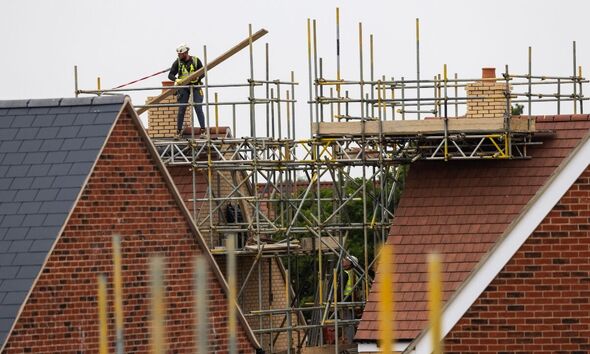

A carpentry firm in business for 15 years has collapsed into administration. Administrators were appointed to A.L.N. Carpentry & Joinery in Newmarket, Suffolk, The Gazette reported on Wednesday (February 11).
The firm carried out work across East Anglia and South East England, including on Peter O'Sullevan House, a rehab centre for injured jockeys in Newmarket, and student accommodation at King's College, Cambridge. Services undertaken by the firm included flooring, joists, roof trusses, decking and cladding, according to its website.
READ MORE: Rachel Reeves's 'jobs tax' is killing High Streets, warns Andrew Griffith
READ MORE: Kemi Badenoch accuses Labour of a 'shameful assault' on our high streets
A.L.N. Carpentry & Joinery hailed its years of experience, solid customer base and high quality of materials. David Kemp and Richard Hunt of Exigen Group Ltd have been appointed joint administrators of the company.
Exigen Group and A.L.N. Carpentry & Joinery have been approached for comment.
The company is one of the latest in the UK to have collapsed into administration. A report by Parliament's Business and Trade Committee this week found that small businesses across the UK are now operating under pressures similar to, and in some cases worse than, those experienced during the Covid pandemic.
Liam Byrne, who chairs the committee, said a "more coherent and ambitious plan" is needed to support businesses. The committee's report found that current pressures are "cumulative, structural and self-reinforcing".
It added that the level of current pressures means there is a risk of accelerating business closures and the Government undermining its growth agenda without action.
The committee highlighted late payments as a specific issue which needs attention, pointing to evidence from Sage indicating that UK small businesses were owed £112billion in unpaid invoices by the end of 2024.
Members of the committee also drew attention to a pattern of closures on UK high streets, after they heard evidence that business rates, retail crime and energy costs are disproportionately affecting bricks-and-mortar businesses.
Government statistics published by Exigen Group in January show there were about 26,005 business insolvencies in the UK last year.
Analysis of data from 5.5 million businesses by insolvency practitioners, Liquidation Centre, pinpoints the towns and cities where high street business collapses are most prolific.
The highest number of liquidated companies was in Norwich (2,933), followed by Manchester (2,534), Glasgow (1,655), Leeds (1,339) and the City of London (1,288), according to Liquidation Centre.
Restaurants proved to be the high street businesses seeing the most liquidations (986), the analysis showed. These were followed by management consultancies and financial management firms (961) and building developers (857).
Richard Hunt, Liquidation Centre director, said: "The data highlights just how volatile recent years have been and continue to be for high street businesses, while also revealing the areas of the UK where local economies may be under the greatest strain.
"These pressures are often driven by a combination of reduced footfall, rising operating costs and wider economic uncertainty."