 Getty Images
Chancellor Rachel Reeves is announcing her Budget, but details were published early by the official forecaster.
Here are the key measures and how they will affect you and your money.
The amount of income at which you pay different rates of income tax will still not be increased in line with rising prices.
Instead the bands - known as tax thresholds - will stay frozen until 2031. That is three years longer than previously planned.
This means any kind of pay rise could drag you into a higher tax bracket, or see a greater proportion of your income taxed than would otherwise be expected.
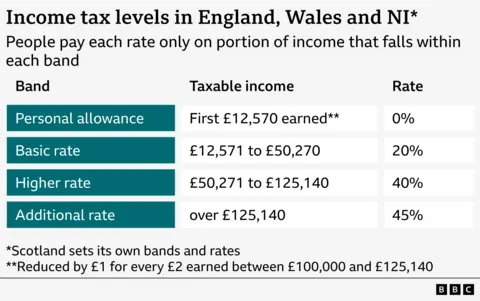
Scotland has its own income tax rates.
You may not earn enough to pay income tax, so VAT, paid when buying goods and services, may hit you harder and that's been left unchanged.
Electric vehicle and hybrid car drivers will be taxed for using the road from 2028.
EV drivers will be charged per mile, on top of other road taxes, in new road pricing.
Calculating the number of miles that drivers cover is difficult.
But fuel duty will continue to be frozen.
The chancellor confirmed increases in April for those on minimum wages.
It means:
The separate apprentice rate which applies to eligible people under 19 - or those over 19 in the first year of an apprenticeship – will also increase to £8 an hour, from £7.55.
Anyone who lives in a home valued at £2m or more in England will face a council tax surcharge from April 2028.
There will be four price bands with the surcharge rising from £2,500 for a property valued in the £2m to £2.5m band, to £7,500 for a property valued in the highest band of £5m or more
While known as a mansion tax, it may also capture homes in expensive areas, and will be levied on about 100,000 properties, primarily in London and south east England.
The move will require the valuation of homes in the top council tax bands - F, G and H - for the first time since 1991.
You can check your council tax band here if you are in England and Wales, Scotland, and Northern Ireland.
Regulated rail fares in England will be frozen until March 2027 - the first time they have been left unchanged for 30 years.
These fares include season tickets covering most commuter routes, some off-peak return tickets on long-distance journeys and flexible tickets for travel in and around major cities.
 Getty Images
The freeze only relates to travel in England, and also only applies to services run by England-based train operating companies.
Train operators are free to set prices for unregulated fares.
The bus fare cap of £3 for a single journey, covering most bus journeys in England, is already in place until March 2027.
The amount of money that can be saved tax-free each year in a cash Isa (Individual Savings Account) will be reduced from £20,000 to £12,000 a year.
Ministers want people to invest more, which comes with greater risk but could help boost growth - a key objective for the government.
There are questions over whether people would naturally put their money into stocks and shares Isas as a result of the less generous tax break on cash Isas.
About a quarter of those who save money into a cash Isa currently save more than £12,000 a year.
But many of those are pensioners, and the chancellor said the over-65s will still be able to save up to £20,000 in cash.
Separately, the Help to Save scheme, which helps those on low incomes and on universal credit to put money aside, will be extended from 2028.
At present, parents can only claim universal credit or tax credits for their first two children.
The chancellor says this two-child cap will be scrapped in April next year.
A third of private sector employees and a tenth of public sector workers use a salary sacrifice scheme for their pension savings.
These workers give up a portion of their salary in return for their employer paying the equivalent amount into their pension. The benefit to both employee and employee is that they make savings in national insurance.
A £2,000-a-year cap on the amount that can be put into pensions through this salary sacrifice arrangement will be in place from April 2029.
Employees would still get income tax relief on their pension contributions, but some argue the move will reduce pension saving incentives.
Some benefits, including all the main disability benefits, such as personal independence payment, attendance allowance and disability living allowance, as well as carer's allowance will rise by 3.8% in April, in line with rising prices.
There will be a string of changes to universal credit in April, following announcements made earlier by the government.
The state pension in April will rise by 4.8% in line with average wages, which means:
In general, you need 35 years of qualifying contributions to get a full state pension.
This brings the state pension closer to being subject to income tax - a source of some debate. It will also reignite discussions over the "fairness" of the so-called triple lock.
A range of other measures in the Budget had already become clear or been announced in recent days. They included: